The world order seems to be reverting fast to a concert of great powers, an oligopoly of competing global hegemons focused on the national interest and the use of raw power to maximize it (Machtpolitik). Along the way they dismantle multilateral fora “to take back control” and carve up the world into spheres of influence “in the interest of national security”. A world order that is based primarily on great powers that show uncooperative behavior toward weaker powers will be a less comfortable place for liberal middle powers such as Germany, Australia, or Japan (Lake 2011).
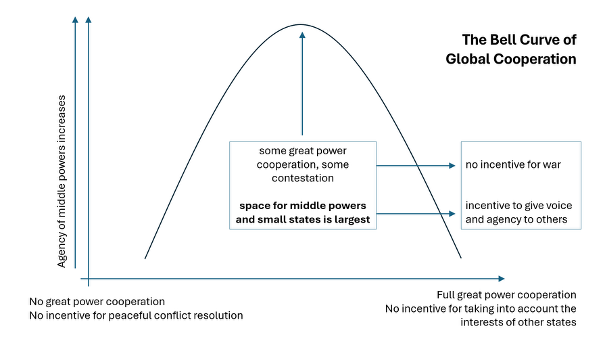
The quality of relations between the major powers is crucial in this emerging world system. The more these relations deteriorate, the greater the risk of confrontation (including military confrontation), which would be extremely costly for all parties involved, great power or not. Conversely, if relations between the great powers become too close and deep, this would have a strong negative impact on the opportunities for middle powers and smaller states to have a say in how the world is run, both within international organizations and outside of them (Corbett/Yi-chong/Weller 2021). This would then effectively be a true concert of great powers, in which almost all decision-making power would be concentrated in an oligopoly of major powers. In sum, the new world order will show elements of great power rivalry and great power cooperation (Haass/Kupchan 2021). The challenge for liberal middle powers will be to identify and stabilize the “sweet spot“ where their agency to influence the new world order is largest.
This new world order could degrade into great power politics without smaller states and against international organizations; especially within spheres of influence it would also pit great powers against the smaller ones. Spheres of influence are essentially very steep hierarchies in which non-hegemonic states enjoy only conditional sovereignty, dependent on decisions taken in the capital of the regional hegemon. The world is witnessing a renaissance of transactionalism, bilateralism, and presidential diplomacy, all trends that strengthen the executive branch of government vis-à-vis parliaments and have been discernible for some time. This prospect has been pushing more dependent states in the Global South towards a policy of multi-alignment (Ben Hammouda 2024), potentially reducing the number of stakeholders for the rules-based international order. Furthermore, this style of great power foreign policy is increasingly at the expense of universalism and multilateralism, central pillars of the post-war order since 1945 (MacMillan 2025).
Against this backdrop, this briefing assumes that – even though the structures of regional and global governance settings are the most important determinants of state behavior – multilateral frameworks are still malleable, creating space for political leadership to break through political gridlock and increase their legitimacy and effectiveness (Wendt 1992). On an abstract level, it will then identify foreign policy instruments which can be deployed by liberal middle powers to strengthen international political frameworks that govern specific issue areas. After all, not just the great powers have the necessary agency to make or break global governance (Eisentraut 2025).
The hypothesis this briefing will propose is that the legitimacy and the effectiveness of issue area frameworks strongly depend on how they are structured, regionally and, by extension, globally. As these frameworks are malleable, influencing their design will affect the “balance of power” within them, leading to policy outputs of varying quality. The main proposition here is that “secretariats” – secretaries-general and their staff in international organizations, rotating presidencies in more informal governance frameworks – will work more diligently towards the fulfillment of the organization’s mandate than member states focused on the maximization of their national interest.
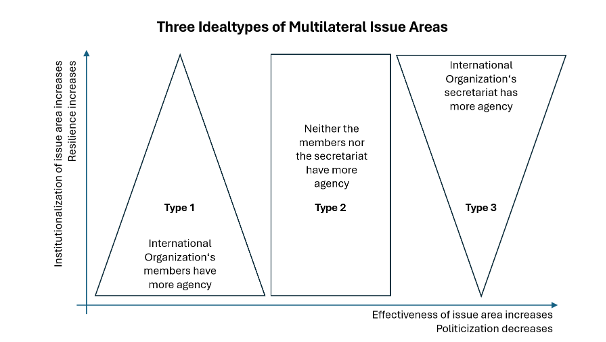
“Bottom-up issue areas” (type 1) are member state-driven frameworks, with weak or no secretariats. Examples are the G7/G20 that deal with many different issue areas under the same (informal) framework, or the Paris Climate Accords (climate) and Agenda 2030 (sustainability) that have no central enforcement mechanism. The more comprehensive and politically sensitive the issue area, the more politicized it tends to be. Legitimacy and effectiveness are then a function of (elusive) member state consensuses on particular questions. “Top-down issue areas” (type 3), by contrast, are secretariat-driven frameworks, such as the WHO (despite the row over COVID-19), or more arcane technical international organizations like the Universal Postal Union (global postal policies and standards) or the International Labour Organization (anti-slavery, labor standards). The OECD also deals with many different issue areas, but falls into this category, as its workings are technical and overwhelmingly apolitical. The more technical and niche the issue area is, the less politicized it tends to be. Here, the legitimacy of an issue area depends on its effectiveness. Finally, “mixed issue areas” (type 2) show a balance between member states and the secretariat, as in the case of the Antarctic Treaty System, although climate change and the great power rivalry are already starting to gridlock the most controversial topics (resource extraction, environmental protection), pushing it towards type 1. Another case in point is the WTO, which has degraded from type 3, now that its effective dispute settlement mechanism has been gridlocked.
International cooperation (regional and global) yields the best results if certain conditions are met: cooperation frameworks need to be seen by their member states as (1) demonstrating effectiveness as an arena for constructive debate and a creator of norms, and (2) enjoying legitimacy so these norms and critiques of enforcement by members will be accepted. Also, these frameworks need to (3) offer opportunities for leadership so that ambitious members (presidential diplomacy) may use them to demonstrate that they are responsible stakeholders, as well as (4) generate some level of followership, a function not simply of the acceptance of individual members’ leadership ambitions, but of high enough levels of trust between members more generally.
Clearly, global governance suffers from deficits in all four conditions, gridlocked as many issue area frameworks seem today (Hale et al. 2013). Great powers can also cause great harm to the rules-based international order – but they have always demonstrated a willingness to engage in institutionalized international cooperation because broad thematic alliances are able to solve transnational problems in a cost-effective manner, and because this also increases the levels of adherence to agreed rules. If the overarching goal of liberal middle powers is to increase the legitimacy of those mechanisms, they should work towards increasing their output effectiveness – commonly a contribution to global public goods in the form of a functioning regulatory framework of a given global governance issue area (trade, health, climate etc.). Top-down issue area frameworks are to be expected in more cooperative (regional and global) systems than in steeply hierarchical orders. However, the world order is not yet such a steep hierarchy, so that the potential benefits of cooperation are still higher than the costs.
How can these theoretical propositions inform political practice? The central foreign policy goal for liberal middle powers interested in protecting the rules-based international order must be to re-legitimize multilateral problem-solving mechanisms – be they centered on international organizations such as the WTO or on more informal governance frameworks such as the G7. Re-legitimation should focus on the output side of these mechanisms, i.e. increasing their ability to function well so that they can generate and enforce norms and rules. The German Federal Government (and many others) calls this “effective multilateralism” (Bundesregierung 2021). This foreign policy goal becomes more achievable the more amenable the global framework conditions are. Or, put differently: The lower the polarity of the world order and, by extension, the tendency towards conflict within the global governance mechanisms in question, the larger the policy space for liberal middle powers to use their agency to strengthen these mechanisms (the “sweet spot”). So, liberal middle powers should invest in both specific global governance mechanisms as well as in the quality of the world system as a whole:
The liberal world order with its universally applicable principles and inclusive international organizations – which, from a global perspective, leads to more efficient results in the production of global goods than a purely transactional world order in which major powers can freely exploit their potential for coercion – has more supporters than it currently appears (Spektor 2025). Liberal middle powers such as Germany and her peer nations around the world have an important role model function in their dealings with their neighboring states as well as with their partners in international organizations, a result of their role-conceptions (Wehner 2020). As they tend to be neither detached powers nor regional dominators (Prys 2010), their leadership ambitions tend to have at least some regional backing. The good news is that together they can exert major influence on the world order at all levels of global governance – so that it not only becomes multipolar but also remains multilateral. It is still “no one’s world” (Kupchan 2012).
Ben Hammouda, Hakim (2024): Multi-alignment and De-risking: The Global South Response to World Fragmentation, Ifri.
Bundesregierung (2021): Gemeinsam für die Menschen. Weißbuch Multilateralismus der Bundesregierung, Bundesregierung.
Corbett, Jack / Yi-chong, Xu / Weller, Patrick (2021): International Organizations and Small States: Participation, Legitimacy and Vulnerability, Bristol.
Eisentraut, Sophie (2025): Going South? Leadership on Global Public Goods, Munich Security Conference.
Haass, Richard N. / Kupchan, Charles A. (2021): “The New Concert of Powers. How to Prevent Catastrophe and Promote Stability in a Multipolar World”, in: Foreign Affairs. https://www.foreignaffairs.com/articles/world/2021-03-23/new-concert-powers
Hale, Thomas / Held, David / Young, Kevin (2013): Gridlock. Why Global Cooperation is Failing when We Need It Most, polity.
Kupchan, Charles A. (2012): No One’s World: The West, the Rising Rest, and the Coming Global Turn, Oxford.
Lake, David A. (2011): Hierarchy in International Relations, Cornell.
MacMillan, Margaret (2025): “Stress Test. Can a Troubled Order Survive a Disruptive Leader?”, in: Foreign Affairs 1/2025, pp. 8-15.
Prys, Miriam (2010): “Hegemony, Domination, Detachment: Differences in Regional Powerhood”, in: International Studies Review 12(4), pp. 479-504.
Spektor, Matias (2025): “The Rise of the Non-Aligned. Who Wins in a Multipolar World?”, in: Foreign Affairs 1/2025, pp. 40-47.
Wehner, Leslie E. (2020): “The Narration of Roles in Foreign Policy Analysis”, in: Journal of International Relations and Development 23(2), pp. 359-384.
Wendt, Alexander (1992): “Anarchy is what States Make of it: The Social Construction of Power Politics”, in: International Organization 46(2), pp. 391-425.
* Dr Christian E. Rieck is Associate Professor of War Studies at the University of Potsdam and Non-Resident Senior Fellow at the Global Governance Institute, Brussels
** This briefing is a condensed version of a book chapter the author wrote for the Konrad Adenauer Stiftung in early 2026. It originally appeared as “Why Institutions Still Matter” in a collection of essays edited by Gunter Rieck Moncayo, titled “Global Economic Governance in a Fragmented World. How Geopolitics Shapes International Cooperation and Its Institutions”. It is published here with the express consent of the foundation.
Is South Sudan Ready to Vote? Assessing the Prospects for a Credible Election in December 2026
is-south-sudan-ready-to-vote-assessing-the-prospects-for-a-credible-election-in-december-2026
Briefing
Peace and Security
September 28, 2026
Justice-Ready by Design: What the UN’s Work with Victims of Terrorism Reveals About Digital Public Infrastructure
justice-ready-by-design-what-the-uns-work-with-victims-of-terrorism-reveals-about-digital-public-infrastructure
Commentary
AI Governance
September 23, 2026

A Start, Not an End: Reflections on the Peace Operations Review Report
a-start-not-an-end-reflections-on-the-peace-operations-review-report
Analysis
Peace and Security
September 21, 2026
European Nuclear Arms and Arms Control in an Age of Uncertainty
european-nuclear-arms-and-arms-control-in-an-age-of-uncertainty
Analysis
Peace and Security
September 10, 2026
A Blueprint for the Global Governance of Autonomous Weapon Systems
a-blueprint-for-the-global-governance-of-autonomous-weapon-systems
Report
Peace and Security
August 28, 2026
AI, Sustainable Development and the Future of Education: A Governance Imperative
ai-sustainable-development-and-the-future-of-education-a-governance-imperative
Commentary
Global Education
August 17, 2026
Financing Syria's Recovery: The EU and a Fragile Economic Opening
financing-syrias-recovery-the-eu-and-a-fragile-economic-opening
Briefing
Global Economy
August 12, 2026
European Defence: The European Union Framework as a Dead End
european-defence-the-european-union-framework-as-a-dead-end
Briefing
Peace and Security
July 22, 2026
The New Development Bank Joins the Shift Towards Nuclear Energy Financing
the-new-development-bank-joins-the-shift-towards-nuclear-energy-financing
Commentary
Global Economy
July 13, 2026
.png)
An Issue Area Approach to Defending Global Governance
an-issue-area-approach-to-defending-global-governance
Briefing
Peace and Security
July 2, 2026

Europe’s Defence Supply Chains Need Africa and the Global South
europes-defence-supply-chains-need-africa-and-the-global-south
Commentary
Global Economy
June 12, 2026

Retrenchment as Policy Failure: Aid Cuts, the Post-UNITAMS Vacuum, and Sudan's Civilian Crisis
retrenchment-as-policy-failure-aid-cuts-the-post-unitams-vacuum-and-sudans-civilian-crisis
Briefing
Peace and Security
May 28, 2026
The Illusion of AI Sovereignty: Mapping the Five-Layer AI Stack
the-illusion-of-ai-sovereignty-mapping-the-five-layer-ai-stack
Commentary
AI Governance
May 15, 2026

Towards a Science for Diplomacy? The U7+ Alliance and the Strategic Repositioning of Universities in Global Governance
towards-a-science-for-diplomacy-the-u-7-alliance-and-the-strategic-repositioning-of-universities-in-global-governance
Commentary
Global Education
April 27, 2026
The Capability Overhang: Cognition and Labor in the Age of AI
the-capability-overhang-cognition-and-labor-in-the-age-of-ai
Commentary
AI Governance
April 9, 2026
.png)
The UN80 Initiative as a Productive Failure: Between Geopolitical Disruptions and Organizational Path Dependency
the-un80-initiative-as-a-productive-failure-between-geopolitical-disruptions-and-organizational-path-dependency
Analysis
Peace and Security
March 31, 2026

Quo Vadis EU-UN Relations in Peace and Security? Evolution, Challenges and Adaptation
quo-vadis-eu-un-relations-in-peace-and-security-evolution-challenges-and-adaptation
Briefing
Peace and Security
February 27, 2026
Higher Education at a Crossroads: Why Europe’s Universities Must Lead, Not Merely Comply
higher-education-at-a-crossroads-why-europes-universities-must-lead-not-merely-comply
Commentary
Global Education
February 23, 2026

What Comes After the US-Israel Strikes on the Islamic Republic?
what-comes-after-the-us-israel-strikes-on-the-islamic-republic
Commentary
Peace and Security
December 19, 2025

Do You Know What’s in Your Skies? Emerging Challenges for Civil Aviation Governance
do-you-know-whats-in-your-skies-emerging-challenges-for-civil-aviation-governance
Commentary
AI Governance
December 18, 2025

Knowledge creation in times of scarce resources in higher education
knowledge-creation-in-times-of-scarce-resources-in-higher-education
Commentary
Global Education
November 10, 2025

Justice-Ready Digital Public Infrastructure: Building a Third Layer of Trust for Democratic Resilience
justice-ready-digital-public-infrastructure-building-a-third-layer-of-trust-for-democratic-resilience
Briefing
AI Governance
October 23, 2025

Is a Greener Future for AI Possible?
is-a-greener-future-for-ai-possible
Commentary
AI Governance
October 20, 2025

Silencing Dissent: How the Tech Backlash Threatens Transitional Justice
silencing-dissent-how-the-tech-backlash-threatens-transitional-justice
Commentary
AI Governance
October 2, 2025

Holding NATO Together and Keeping the US Engaged: Strategic Implications of the Hague Summit
holding-nato-together-and-keeping-the-us-engaged-strategic-implications-of-the-hague-summit
Analysis
Peace and Security
September 9, 2025

Reforming the UN during a financial crisis: a foreseeable failure to align money, mandates, and majorities?
reforming-the-un-during-a-financial-crisis-a-foreseeable-failure-to-align-money-mandates-and-majorities
Briefing
Peace and Security
July 9, 2025

How do we measure the quality of education?
how-do-we-measure-the-quality-of-education
Commentary
Global Education
April 28, 2025

Bound to Fail? The Limits of Diplomacy in the Russia–Ukraine War and the Future of European Security
bound-to-fail-the-limits-of-diplomacy-in-the-russia-ukraine-war-and-the-future-of-european-security
Commentary
Peace and Security
April 8, 2025

A major shift in global higher education is underway: why collective leadership and governance are more important than ever
a-major-shift-in-global-higher-education-is-underway-why-collective-leadership-and-governance-are-more-important-than-ever
Commentary
Global Education
March 26, 2025

AI's Fast-Forward Button: Can We Harness Innovation Without Sacrificing Safety?
ais-fast-forward-button-can-we-harness-innovation-without-sacrificing-safety
Commentary
AI Governance
March 10, 2025
Parliaments in the EU enlargement process: Strengthening capacities of accession country parliaments under the evolving enlargement methodology
parliaments-in-the-eu-enlargement-process-strengthening-capacities-of-accession-country-parliaments-under-the-evolving-enlargement-methodology
Report
Democracy and Human Rights
January 30, 2025
%20(1200%20x%20600%20px)%20(1200%20x%20400%20px).png)
Synthetic Biology and the Future of Global Environmental Governance
synthetic-biology-and-the-future-of-global-environmental-governance
Analysis
Global Environmental Governance
January 28, 2025

Towards a Global Agency for Governing Artificial General Intelligence: Challenges and Perspectives
towards-a-global-agency-for-governing-artificial-general-intelligence-challenges-and-perspectives
Report
AI Governance
January 14, 2025

Normalizing Russia can become Trump’s biggest mistake, but it’s not too late to prevent it
normalizing-russia-can-become-trumps-biggest-mistake-but-its-not-too-late-to-prevent-it
Commentary
Peace and Security
January 13, 2025

Stabilizing Europe’s Security Architecture after the Russo-Ukraine War? The Future of Conventional Arms Control in Europe
stabilizing-europes-security-architecture-after-the-russo-ukraine-war-the-future-of-conventional-arms-control-in-europe
Briefing
Peace and Security
November 20, 2024

INTERPOL: Challenges and Opportunities for the New Secretary General
interpol-challenges-and-opportunities-for-the-new-secretary-general
Commentary
Peace and Security
November 7, 2024

A Fork in the Road? The Kazan Summit of the BRICS
a-fork-in-the-road-the-kazan-summit-of-the-brics
Briefing
Peace and Security
October 30, 2024

UN Summit of the Future and Development: The Way Forward
un-summit-of-the-future-and-development-the-way-forward
Briefing
AI Governance
October 24, 2024
ECOWAS after the ‘Triple Withdrawal’ and the creation of the Alliance of Sahel States
ecowas-after-the-triple-withdrawal-and-the-creation-of-the-alliance-of-sahel-states-challenges-and-ways-ahead-for-regional-security-governance
Analysis
Peace and Security
October 7, 2024
Rushing to Peace, Racing to War: The Challenge of a Just Settlement
rushing-to-peace-racing-to-war-the-challenge-of-a-just-settlement
Commentary
Peace and Security
September 30, 2024
UN Summit of the Future: A Critical Moment for Global AI Governance
un-summit-of-the-future-a-critical-moment-for-global-ai-governance
Commentary
AI Governance
September 20, 2024

Shattered Security: Gender And Coups In Guinea, Mali, And Burkina Faso
shattered-security-gender-and-coups-in-guinea-mali-and-burkina-faso
Briefing
Peace and Security
June 26, 2024
Before the Peace Summit: Testing Multilateralism and Ukrainian Diplomacy
before-the-peace-summit-testing-multilateralism-and-ukrainian-diplomacy
Commentary
Peace and Security
June 14, 2024
The On-Going Quest for Teaching Excellence
the-on-going-quest-for-teaching-excellence
Commentary
Global Education
June 11, 2024

Deepening EU-Japan-US Cooperation on Critical and Emerging Technologies
deepening-eu-japan-us-cooperation-on-critical-and-emerging-technologies
Commentary
AI Governance
May 7, 2024
UNRWA’s Funding Freeze was Unjustified and Undermined Good Governance
unrwas-funding-freeze-was-unjustified-and-undermined-good-governance
Briefing
Democracy and Human Rights
April 25, 2024

Israel’s Non-implementation of the ICJ’s Provisional Measures: International Law Must Be Upheld
israels-non-implementation-of-the-icjs-provisional-measures-international-law-must-be-upheld
Briefing
Democracy and Human Rights
April 2, 2024

The EU AI Act: two steps forward, one step back
the-eu-ai-act-two-steps-forward-one-step-back
Briefing
AI Governance
March 19, 2024

The Council of Europe’s draft AI Treaty: balancing national security, innovation and human rights?
the-council-of-europes-draft-ai-treaty-balancing-national-security-innovation-and-human-rights
Commentary
AI Governance
March 18, 2024
The Ukrainian Peace Formula: content, evolution and diplomatic outreach
the-ukrainian-peace-formula-content-evolution-and-diplomatic-outreach
Analysis
Peace and Security
February 26, 2024
What developments in AI tell us about the future of governance models
what-developments-in-ai-tell-us-about-the-future-of-governance-models
Commentary
AI Governance
February 21, 2024

Whither the Global Governance of Protecting Civilians? An Initial Assessment of the ICJ’s Decision on South Africa v. Israel of 26 January 2024
whither-the-global-governance-of-protecting-civilians-an-initial-assessment-of-the-icjs-decision-on-south-africa-v-israel-of-26-january-2024
Analysis
Democracy and Human Rights
February 14, 2024
How Ukraine uses AI to fight Russian information operations
how-ukraine-uses-ai-to-fight-russian-information-operations
Commentary
AI Governance
February 12, 2024

Got trust? Global governance of emerging technologies
got-trust-global-governance-of-emerging-technologies
Commentary
AI Governance
November 28, 2023

Last minute national objections to the EU’s AI Act are a mistake. Here’s why
rolling-back-the-ai-act-is-a-mistake-heres-why
Commentary
AI Governance
November 27, 2023

Contributions of Latin America and the Caribbean to UN Peace Operations and Recommendations to Increase this Participation
new-ggi-advice-report-latin-american-and-caribbean-countries-contributions-to-un-peacekeeping
Report
Peace and Security
October 12, 2023
Armed Conflict in Nagorno-Karabakh: Crisis, Exodus, and Ethnic Cleansing
armed-conflict-in-nagorno-karabakh-crisis-exodus-and-ethnic-cleansing
Briefing
Peace and Security
October 9, 2023

Thinking of Eloho – One Year On
thinking-of-eloho-one-year-on
Commentary
Peace and Security
August 12, 2023
The Strategic Compass and the EU's Security & Defence Partnerships
the-strategic-compass-implementing-the-partnership-dimension-in-the-area-of-security-and-defence
Report
Peace and Security
July 23, 2023

Franco-German Perspectives: Europe's Moment of Geopolitics
franco-german-perspectives-europes-moment-of-geopolitics
Commentary
Peace and Security
June 2, 2023
A Comprehensive Mapping of National Higher Education Teaching Qualification schemes, Requirements and Provisions for the Promotion and Reward of Teaching Excellence
a-comprehensive-mapping-of-national-higher-education-teaching-qualification-schemes-requirements-and-provisions-for-the-promotion-and-reward-of-teaching-excellence
Report
Global Education
June 1, 2023

Stefaan de Rynck 'Inside the deal: How the EU got Brexit Done'
stefaan-de-ryncks-inside-the-deal-how-the-eu-got-brexit-done
Commentary
Global Education
April 5, 2023
NATO Allies and the Protection of Civilians
nato-allies-and-the-protection-of-civilians
Analysis
Peace and Security
January 11, 2023
Why Jettison Erasmus? The negative consequences for the UK of walking away
why-jettison-erasmus
Commentary
Global Education
January 1, 2021

Doing less with more? The difficult return of Western troop contributing countries to UN Peacekeeping
doing-less-with-more
Analysis
Peace and Security
November 2, 2020
The European Union's Role in International Economic Fora – Paper 4: The IMF
the-european-unions-role-in-international-economic-fora-paper-4-the-imf
Report
Global Economy
September 1, 2015
Civil Society Reforms in Uzbekistan: More than Government Chicanery?
civil-society-reforms-in-uzbekistan-more-than-government-chicanery
Briefing
Peace and Security
January 1, 2014
Assessing the EU’s Joint Communication on the Comprehensive Approach: Implications for EU Crisis Response and Conflict Prevention
assessing-the-eus-joint-communication-on-the-comprehensive-approach
Briefing
Peace and Security
December 15, 2013
The EU Foreign Policy of My Dreams: Ten Wishes
the-eu-foreign-policy-of-my-dreams-ten-wishes
Views from Practice
Peace and Security
December 12, 2013
The Middle East as weapons of mass destruction free zone: A proposal to overcome the deadlock
the-middle-east-as-weapons-of-mass-destruction-free-zone-a-proposal-to-overcome-the-deadlock
Views from Practice
Peace and Security
October 15, 2013

From a Militarized to a Humanized Responsibility to Protect
from-a-militarized-to-a-humanized-responsibility-to-protect-integrating-the-red-cross-and-red-crescent-into-rtop-to-respond-to-natural-disasters-and-global-climate-change
Analysis
Global Environmental Governance
June 1, 2013
Leading the Peacebuilding Commission: An Institutional History in the Making
leading-the-peacebuilding-commission-an-institutional-history-in-the-making
Views from Practice
Peace and Security
March 1, 2013
Anticipating the “Final” Arms Trade Treaty Conference: Eight Concrete Proposals
anticipating-the-final-arms-trade-treaty-conference-eight-concrete-proposals
Analysis
Peace and Security
February 1, 2013

Report for the Inquiry into the European External Action Service – EU sub-committee on External Affairs of the House Of Lords
report-for-the-inquiry-into-the-european-external-action-service---eu-sub-committee-on-external-affairs-of-the-house-of-lords
Briefing
Peace and Security
December 1, 2012
Government and the Process of Governance in Africa
government-and-the-process-of-governance-in-africa
Analysis
Peace and Security
November 1, 2012
The Responsibility to Protect and the Responsibility while Protecting: Friends or Foes?
the-responsibility-to-protect-and-the-responsibility-while-protecting-friends-or-foes
Analysis
Democracy and Human Rights
September 15, 2012

Montenegro’s Accession To The EU: Taking Stock And Suggesting Areas For Progress
montenegros-accession-to-the-eu-taking-stock-and-suggesting-areas-for-progress
Briefing
Democracy and Human Rights
August 1, 2012

Electing Freedom? Key Challenges For Libya After The 7 July 2012 Election
electing-freedom-key-challenges-for-libya-after-the-7-july-2012-election
Briefing
Peace and Security
August 1, 2012

The Somali Crisis and the EU: Moving Onshore and Committing to Somalia
the-somali-crisis-and-the-eu-moving-onshore-and-committing-to-somalia
Analysis
Peace and Security
July 1, 2012
United Nations - European Union Cooperation in the Field of Peacekeeping: Challenges and Prospects
united-nations-european-union-cooperation-in-the-field-of-peacekeeping-challenges-and-prospects
Analysis
Peace and Security
June 1, 2012
Widening The Huntress’s Reach: Legal And Strategic Aspects Of A New Atalanta Mandate
legal-and-strategic-aspects-of-a-new-atalanta-mandate
Briefing
Democracy and Human Rights
April 15, 2012

The Biological Weapons Convention, Bioterrorism And The Life Sciences
the-biological-weapons-convention-bioterrorism-and-the-life-sciences
Briefing
Peace and Security
April 1, 2012

A Democratic Justification for Military and Non-military Humanitarian Intervention
a-democratic-justification-for-military-and-non-military-humanitarian-interventions
Analysis
Democracy and Human Rights
April 1, 2012

Climate Change and Security: Adapting the Discussion to the Evidence
climate-change-and-security
Briefing
Global Environmental Governance
March 15, 2012
The United Nations Entity for Gender Equality and the Empowerment of Women (UN Women)
the-united-nations-entity-for-gender-equality-and-the-empowerment-of-women-un-women
Backgrounder
Peace and Security
September 1, 2011

The International Criminal Court and Kenya’s Post-election Violence
the-international-criminal-court-and-kenyas-post-election-violence
Analysis
Democracy and Human Rights
July 15, 2011

The United Nations Peacebuilding Architecture: Background Note
the-united-nations-peacebuilding-architecture-background-note
Briefing
Peace and Security
March 1, 2011
European Civilian Crisis Management Capacities: Bridging The Resources Gap?
european-civilian-crisis-management-capacities-bridging-the-resources-gap
Briefing
Peace and Security
January 15, 2011

The Changing Constellation of Power and Resistance in the Global Debate over Agrofuels
the-changing-constellation-of-power-and-resistance-in-the-global-debate-over-agrofuels
Analysis
Global Environmental Governance
January 1, 2011