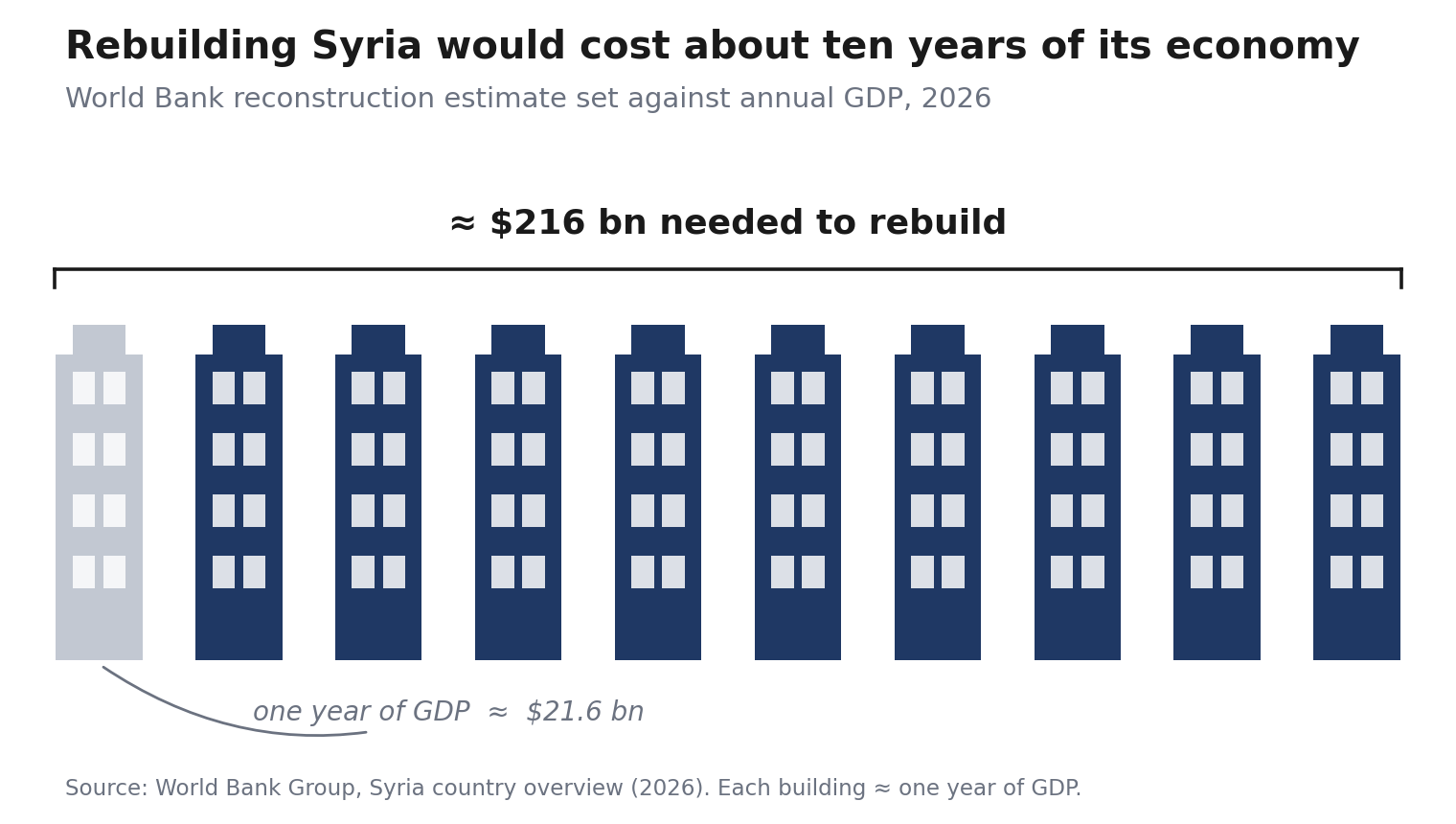
Syria is in the most significant economic opening it has known in over a decade. Since the fall of the old regime in December 2024, the new authorities have committed to a market-based economy, the European Union and the United States lifted sanctions in mid-2025, and growth for 2026 is projected near ten percent. Against this stands a reconstruction bill the World Bank estimates at roughly 216 billion US dollars, about ten times annual GDP, and a financial system still lack access to much of the world.
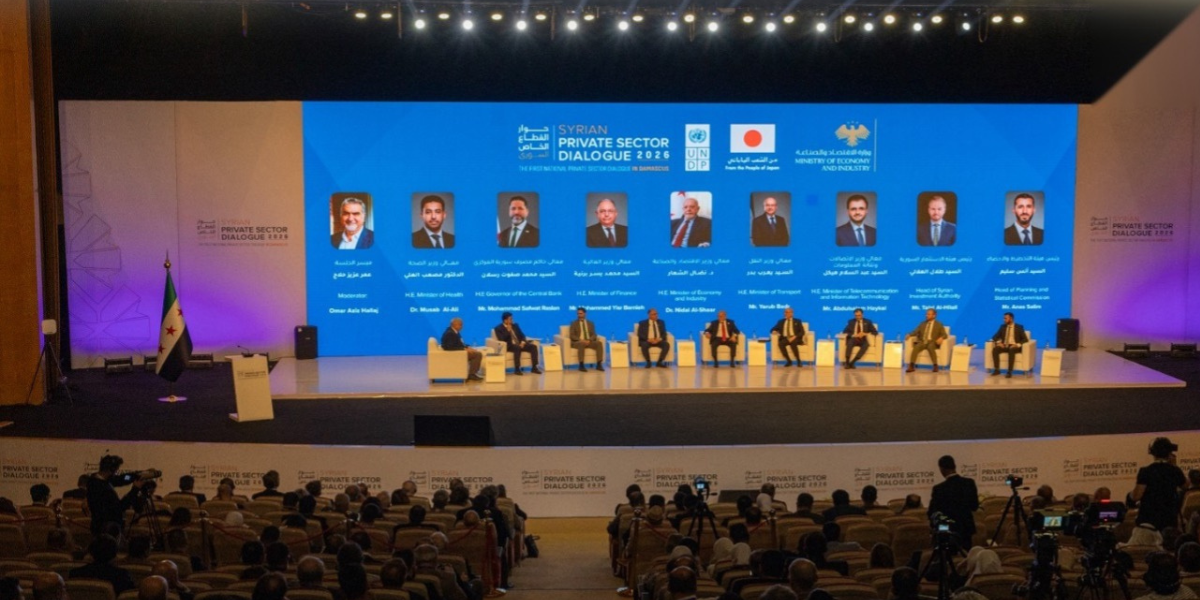
For the EU, which ended the partial suspension of its cooperation agreement with Damascus in May 2026, pledged a recovery package of roughly 175 million euros with a further 180 million envisaged, and has announced an investment conference for late 2026, the question is no longer whether to engage but how? This brief argues that Europe's real leverage lies less in the capital it supplies than in what it can de-risk and how it sequences its engagement behind Syria's own reform agenda. It builds on the discussions of the National Private Sector Dialogue (PSD-2026, Damascus, 1-3 June), which the author attended, and closes with time-specific recommendations addressed to EU institutions.
Syrians waited too long to see the old regime fall in December 2024. When it finally did, the regional and international environment favored them: Russia was focused on the war in Ukraine, and Hezbollah had been weakened by Israel, especially after the assassination of Hassan Nasrallah. Combined with the strategic timing of the operation led by President Ahmad al-Sharaa, which defied the expectations of regional and world leaders, this opened the door to rapid change in Syria's economic environment. The authorities committed to a market-based economy and to dismantling the monopolies and corruption of the previous era, and the EU lifted sanctions in May 2025, with the United States following by executive order in June 2025.1 Growth projections for 2026 approach ten percent, roughly double the prior year, supported by improved security, returning professionals, and early infrastructure and energy investment from regional partners.
International financial re-engagement has resumed, although more slowly than it was hoped by the interim authorities. Arab countries were among the first to help the new authorities, as they had grown fed up with the old regime and were at the brink of re-engaging with it, where the arrival of the new authority meant for the Arabs a breakthrough from dealing with Iranian militias, and with a country that exported its refugees and served as a hub for drugs and illegal substances in the region. For this reason, Qatar and Saudi Arabia stepped in and cleared Syria's arrears to the International Development Association in May 2025, allowing Syria to restore World Bank eligibility after a fourteen-year suspension; the IMF appointed its first mission chief since 2009; and the World Bank began establishing a permanent presence in Damascus.2 Domestically, Presidential Decree No. 114 of 2025 rewrote the investment framework inherited from 2021 by the old regime. Where it tried to modernize its investment environment and make it more attractable by creating the Syrian Investment Authority as a single licensing window, guaranteed full foreign ownership, the repatriation of profits and recourse to international arbitration, and layered on generous tax and customs relief, including reductions of up to eighty per cent for export-oriented industry. For many (Foreign investors and business diaspora) this matters because it is the first legal signal to foreign capital in a generation. It is also contested: the same decree places both the Investment Authority and a new Supreme Council for Economic Development under the presidency, concentrating decisions over licenses and state land in the executive, and analysts have warned that this risks a system of directed access rather than open competition.3
Yet the scale of the need far exceeds current capacity as the level of destruction is catastrophic in many cities within Syria. Reconstruction is estimated at roughly ten years of Syria's entire economic output (Figure 1), and the gap cannot be closed by public money, Syrian or foreign. Recovery depends on private capital, which is why the state of the private sector and the conditions it faces are the central policy question.
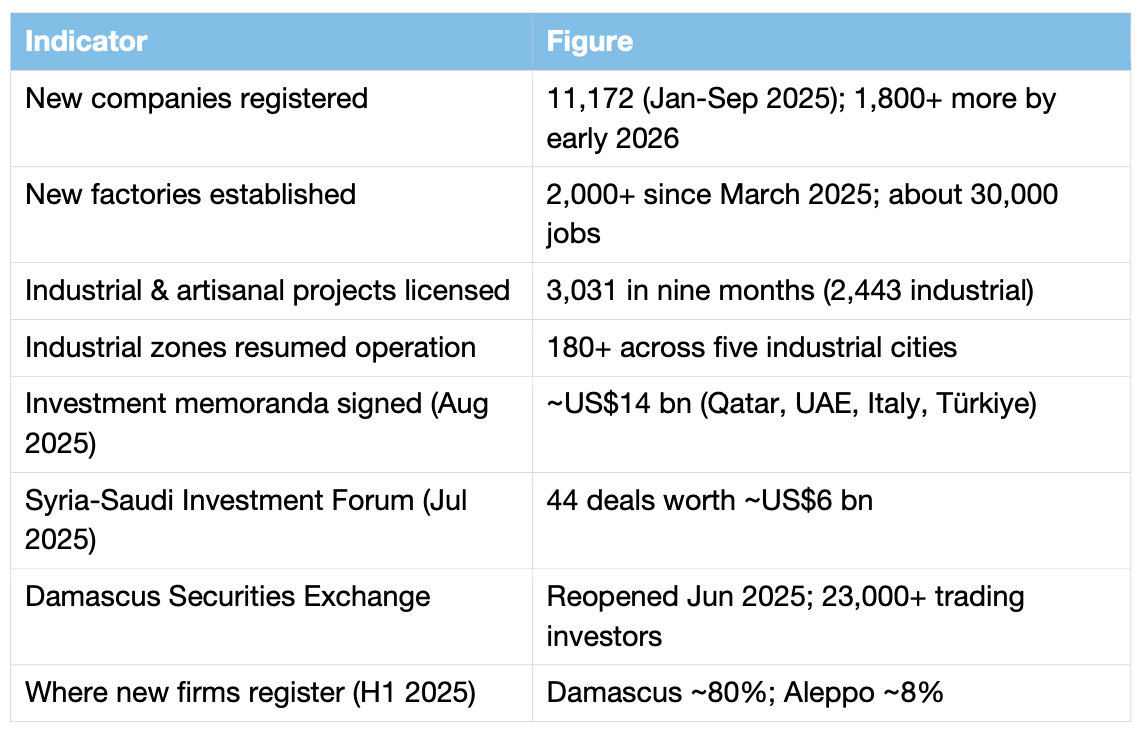
The early signs of a private-sector revival are real and provide strong indicator to the world. Numbers presented at the Private Sector Dialogue indicated that over 11,000 companies were registered between January and September 2025, more than 2,000 new factories have been established since March 2025 creating roughly 30,000 jobs, and the Damascus Securities Exchange reopened in June 2025 after a seven-month closure (Figure 2).4 These figures should be read with caution: several originate with government bodies, and headline deal values reflect signed memoranda rather than disbursed capital. The rebound is also uneven. Damascus and its outskirts captured over 80 percent of new company registrations in the first half of 2025, while Aleppo, the pre-war industrial heartland, drew about 8 percent.5
There is not much of an institutional relationship to build on, this relates to the old regime directions as it was considered a leftist party (Al Bath), built on a communist foundation, oriented towards socialism and a Soviet heritage. It was only after the death of Hafiz Al Asad and the takeover by his son Bashar that we see a shift towards more openness with the EU. This was reflected in the EU-Syria Association Agreement, initialled in 2008, that was never signed; the 1977 Cooperation Agreement that still governs relations was partially suspended in September 2011, and for more than a decade the relationship was defined by sanctions, humanitarian aid channelled around the state and international organizations, and the political conditions of the 2017 EU Syria strategy. The fall of the old regime removed the barrier on which that relationship rested, powered by the refugee crisis that affected not only the neighbouring countries but also the Entire European Union, and Brussels has spent 2025 and 2026 rebuilding a relationship with a government it does not yet fully trust but cannot afford to ignore.6
Re-engagement has moved quickly by Brussels standards. Sanctions were lifted in May 2025. In May 2026 the EU ended the partial suspension of its cooperation agreement with Damascus, pledged a socio-economic recovery package of roughly 175 million euros with a further 180 million euros envisaged across 2026, and announced an investment conference for late in the year.7 The EU's envoy in Damascus has called publicly for large-scale investment and stronger public-private cooperation, and European institutions are hosting technical work on restoring banking intermediation.8
Member states are moving at a faster pace than Brussels. In early July 2026 Emmanuel Macron travelled to Damascus, the first western European leader to do so since the fall of the old regime, a year after receiving Al-Sharaa in Paris. The visit produced practical commitments, French technical assistance for Syria's banking sector and cooperation on transport, that map onto the constraints described here. It also showed how fragile the setting remains: explosions wounded at least eighteen people in the capital while the two presidents met, before both travelled on to the NATO summit in Ankara. The signal to other European capitals, and to European firms waiting for political cover, was clear enough: engagement with Damascus is no longer only an American and Gulf affair; it is rather a European interest.9
Europe is not doing this for charity. A stabilised Syria means managed refugee returns, calmer borders, and a reconnected market on the EU's periphery. But the relationship carries an unresolved tension between conditionality, the instinct to tie money to reform and transitional-justice benchmarks, and engagement, the recognition that an early-recovery state needs support before it can meet benchmarks. How the EU manages that tension will shape not only its own programmes but the behaviour of European banks and investors watching for signals.
Banking is where the recovery is stuck, an issue heavily discussed at the Private Sector Dialogue by both bankers and investors, who reiterated its effects. Sanctions are formally gone, yet persistent over-compliance by international banks continues to choke payments, trade finance, and investment flows. Syrian firms report that the reluctance of banks, especially in the EU and US, to process transactions is the single largest obstacle to trade and to the entry of foreign companies.10 The first analysis indicates that no Syrian reform can fix this on its own, because the problem sits with the risk appetite of foreign institutions, and European regulators and supervisors have more influence over it than anything decided in Damascus.
Underneath the policy files sits a more personal source of hesitation: the president's own background. Ahmad Al-Sharaa led Hay'at Tahrir al-Sham (HTS), a group that originated as Jabhat al-Nusra, al-Qaeda's Syrian affiliate, before breaking with it in 2016, and he spent years on terrorism sanctions lists under his “nom de guerre”. Those links, together with episodes of sectarian violence that affected the country (namely Al Sahel and Swaida) since the transition and open questions about foreign fighters and extremist elements within the security forces, sustain real fears, among Syria's minorities at home and among sceptics in European capitals, that the new order may not outgrow its origins.
The political trajectory, however, has moved decisively toward rehabilitation, and Washington has led it. The United States lifted sanctions in June 2025 and revoked HTS's terrorist designation that July, following President Trump's meeting with Al-Sharaa in Riyadh, after which Trump was openly admiring of the Syrian president, declaring that he has 'done a great job.' Subsequently, in November 2025, the UN Security Council removed Al-Sharaa from the ISIL and Al-Qaida sanctions list by fourteen votes to none, citing the transitional government's commitments to combat terrorism and uphold human rights; days later he became the first Syrian head of state ever received at the White House, and Syria joined the US-led coalition against ISIS. For the EU, the practical way to ease the remaining fears is to benchmark engagement on observable conduct, protection of minorities, accountability for sectarian violence, and the handling of foreign fighters, rather than focusing on a past that Washington and the Security Council have already moved beyond. Trust can then grow step by step, as the new authorities demonstrate through their conduct that it is warranted.11
Syria's recovery scene is crowded with institutions (both local and international), and their weight is very uneven. Some hold money, some hold convening power, and a few control the technical gates that decide whether anyone else's money can move at all. The table below sets out who is doing what. The paragraphs that follow take the three groups whose behaviour most directly narrows or widens the EU's own options.
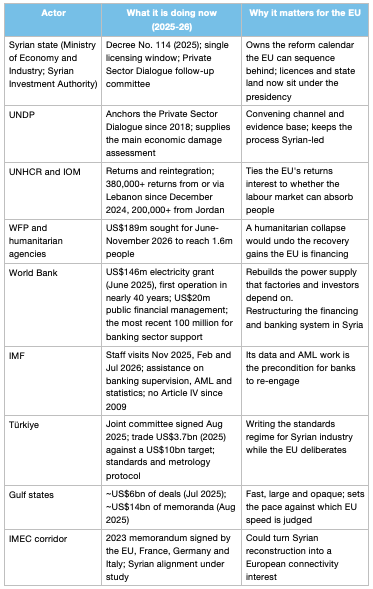
The Syrian state: the authorities have settled on a reform agenda with broad private-sector backing: legal certainty, simpler administration, access to finance, trade facilitation.12 The institutional test is the follow-up committee proposed under the Ministry of Economy and Industry, with private members sitting alongside officials. Whether it becomes a genuine monitoring body or a courtesy is the most important domestic variable in this brief, and nothing yet settles it. Capacity is the visible weakness: the central bank is steering a currency that touched 14,500 to the dollar during the replacement operation, and officials agree that reliable statistics barely exist and require more time to build.13
The UN system: UNDP is easy to underestimate. It has anchored the Private Sector Dialogue since 2018, but its more consequential contribution is analytical: its damage assessment is the baseline others argue from. Poverty rose from 33 per cent before the war to about 90 per cent, and on current growth Syria would not regain its pre-war GDP before 2080, with recovery inside a decade requiring growth six times faster than today's. That puts the EU's 175 million euros in proportion. It is not reconstruction money and should not be sold as such; its only defensible purpose is catalytic. As mandated, UNHCR and IOM carry the returns file, and more than 380,000 Syrians have returned from or through Lebanon since December 2024 and almost 200,000 returned from Jordan by mid-2026, faster than the economy can absorb them, which is where Europe's migration interest and its economic policy actually meet. WFP needs 189 million dollars to feed 1.6 million people through November 2026. If humanitarian funding fails before recovery investment lands, the returns Europe wants will not happen any time soon.14
The international financial institutions: the IMF and World Bank can be seen as less important for the sums they move than for the gates they control. The Bank's 146 million dollar electricity grant in June 2025 was its first Syrian operation in nearly four decades, followed by a smaller public financial management programme and further projects for 2026 and 2027. In August 2026 the Board approved a further US$100 million grant for financial sector modernization, covering payment systems, supervision of public and private banks, and precisely the anti-money-laundering capacity that European banks say they need to see. Electricity is the right starting point, since power shortages are among the hardest constraints on the factories flagged in Figure 2. The Fund's role is quieter and, for Brussels, more useful: staff visits in November 2025 and in February and July 2026, technical assistance on banking supervision, anti-money-laundering and statistics, and a condition that Article IV consultations, suspended since 2009, resume only once the data improve. That condition is why statistics are not an afterthought. No Article IV means no independent macroeconomic assessment of Syria, and without one European banks lack the baseline their compliance departments demand. This resulted in latest announced 100 million grant to support the banking systems and data in Syria. Yet the Fund's data agenda and the EU's banking problem are a problem approached from two ends.15
Regional partners: Türkiye is the clearest case of an actor moving faster than Brussels. Its joint economic and trade committee was signed in Ankara in August 2025, bilateral trade between the two reached about 3.7 billion dollars in 2025, and the declared target is 10 billion. More important than the numbers is the accompanying protocol, which covers product safety, technical regulations, standardization, conformity assessment and metrology. In other words, Türkiye is writing the rulebook Syrian manufacturers will build to. As per general understanding, standards are sticky; whoever supplies them first shapes what Syrian exporters can sell and where, and the EU is not in that conversation. Gulf commitments are larger but looser, roughly 6 billion dollars of deals in July 2025 and 14 billion in memoranda a month later. Against a 216 billion dollar reconstruction bill that is a fraction of the need, and most of it is signature rather than disbursement. With Gulf money the question is conversion, not volume.16
Transit geography: the India-Middle East-Europe Economic Corridor (IMEC) deserves more European attention than it currently receives, if only because the EU signed the September 2023 memorandum in its own right, alongside France, Germany and Italy, and Global Gateway is how Europe would fund its share. The corridor was planned to run from India through the Gulf to Jordan and Israel's Haifa port before crossing to Europe. With Saudi-Israeli normalization stalled, an alignment reaching the Mediterranean through Syria is under examination, and in April 2026 Türkiye, Jordan and Syria agreed to develop a north-south link intended to reach the Saudi network. A Syrian route looks plausible but not imminent: feasibility work runs to the end of 2026, Syrian rail and road assets need rebuilding, and security is unresolved, as the explosions during Macron's visit showed. The near-term value to Brussels is leverage rather than freight, and that is reason enough to fund transport standards, customs systems and border infrastructure now, while the route is still open and under discussion.17
The EU and the UN now frame recovery around the same instruments: public-private partnership, access to finance and a better investment climate. The overlap is real, and the same applies to the coordination problem it creates. To be clear, the duplication described here has not happened yet; The writer sees it as a foreseeable risk whose indications are already visible: Brussels has announced an investment conference for late 2026, while UNDP is preparing a follow-up committee that is meant to produce its own reform calendar. Both point at the same few ministries, and parallel donor processes elsewhere have tended to multiply reporting demands on the administrations least able to meet them.
Generally speaking, sequencing is an administrative act, not a principle. In practice it means three specific things: one prioritized reform list rather than two, agreed between the follow-up committee and the EU delegation; a conference agenda whose sessions are drawn from that list; and a single reporting cycle, so that ministries are asked to account for progress once a quarter instead of twice. Europe's leverage is limited at this point and should be spent where nobody can substitute for it, which means the supervisory side of banking and the guarantees that determine whether private investors follow the memoranda already signed.
Syria's openness is real but fragile, and the window in which reform momentum, regional interest and international goodwill coincide will not stay open indefinitely. Three constraints are worth mentioning: the banking channel, the state's capacity to implement, and the poor quality of public data. In addition, the political situation requires additional monitoring and good governance decisions, particularly from a European perspective when it comes to the Syrian government’s future decisions on its foreign relations, including its relations with Russia. Overall, four measures are therefore suggested that would make the most difference, particularly if advanced by the suggested institutions indicated in parentheses.
1. Unblock the banking channel first (European Commission, European Banking Authority (EBA) and Anti-Money Laundering Authority (AMLA) supervision, with the IMF; guidance before the late-2026 conference). Banks are not refusing Syrian payments because the law forbids them, but because no supervisor has told them the residual risk is acceptable. That is what over-compliance means: applying stricter standards than the rules require. The solution is supervisory communication. DG FISMA, the European Banking Authority and AMLA, with ECB Banking Supervision and national supervisors, should issue joint guidance confirming that Syria-related transactions are permitted after the 2025 sanctions relief and the November 2025 delistings and the July 2026 decision to rescind Syria's designation as a State Sponsor of Terrorism, and setting out the due diligence expected. On the Syrian side, the IMF's existing anti-money-laundering assistance to the Central Bank should be empowered to meet that standard. Guidance before the conference; correspondent relationships restored during 2027.
2. Hold the investment conference inside Syria's reform calendar, not beside it (the European External Action Service (EEAS) and DG MENA with UNDP and the Ministry of Economy and Industry, by Q4 2026). The Private Sector Dialogue follow-up committee should publish one prioritized reform matrix before the end of 2026, each item with a named owner and a quarterly milestone. The EU delegation should build the conference agenda from that document, which is already in development, rather than drafting a parallel one, and UNDP should provide a single joint secretariat so both tracks report on the same cycle. Refugee-return incentives belong in a separate instrument; folding them into the matrix would politicize it and teach Syrian counterparts to read every economic condition as a migration condition.
3. Open a joint EU-UN guarantee window (European Investment Bank (EIB) or European Bank for Reconstruction and Development (EBRD) hosting, capitalized from the recovery package, first transactions in 2027). De-risking and blended finance describe a simple arrangement: public money absorbs the first losses so that commercial lenders will carry the burden. Concretely, a guarantee window hosted by the EIB in the near term, since Syria is eligible for EBRD membership but has not yet joined and EU shareholders should support an application, capitalized from the EU's socio-economic package, with UNDP and the Syrian Investment Authority screening the pipeline and a first-loss tranche of the order used in existing EU blended-finance operations. Electricity, logistics and SME lending are the sensible first sectors. Success is measured in memoranda converted into disbursed capital, not in commitments announced.
4. Pay for the data collection, processing and administration on which everything else depends (EU statistical twinning and IMF assistance to Syrian ministries, through 2027). Who would actually collect the data is a fair question. The answer is the Syrian statistical office and the Ministry of Economy and Industry, which is where the gap sits, supported by the IMF programme already running and by twinning with EU national statistical institutes of the kind used in enlargement countries. The immediate objective is clear: meet the conditions the IMF has set for resuming Article IV consultations, suspended since 2009. That unlocks an independent macroeconomic assessment and gives banks and investors the baseline they currently lack. Reporting on women- and youth-led enterprises should sit in the same system from the start, so that inclusion is measured by the institution that measures everything else.
These steps would give the EU a central role in turning Syria's declared intent into governed reform. It would also strengthen the EU's future relations with a country that may come to play a significant role in transport routes and would allow for a fast yet directed recovery that makes return for the Syrian diaspora a more desirable option rather than a continuing risk and insurmountable challenge.
1. Middle East Institute, Syria's 2026 Economic Outlook, Prospects, and Priorities, 2026; The Media Line, Beyond Sanctions: The Hard Economics of Syria's Recovery, 2026; IMF staff statement of 4 August 2026 projecting growth above ten per cent for 2026, reported in Enab Baladi, IMF: Syria's Economy Could Grow by More Than 10% in 2026, August 2026.
2. World Bank Group, Syria country overview, https://www.worldbank.org/ext/en/country/syria; IMF, IMF Staff Concludes Staff Visit to Damascus, PR 25/377, 17 November 2025; IMF, IMF Staff Concludes Staff Visit to Syria, PR 26/062, 25 February 2026.
3. Presidential Decree No. 114 of 2025, amending Investment Law No. 18 of 2021; Middle East Institute, Syria's New Investment Law and the Return of State-Mediated Market Access, 2026; SANA, Syria allows full foreign ownership of projects under new investment reforms, 2025; UNCTAD Investment Policy Monitor, Syrian Arab Republic: facilitates repatriation of profits by foreign-owned companies; for the centralisation critique, Western Syria Development, Syria's New Investment Law: Centralizing Economic Power and Constraining Recovery, 2026.
4. Arab News, Syria seeks major investors as 180 industrial zones resume operations, 2026; Enab Baladi, Syria licenses 3,031 industrial and craft projects in nine months, November 2025; SANA, Syria registers over 1,800 new companies in 2026, 2026.
5. The Syrian Observer, Damascus Dominance: Why the Capital Captures 80% of Syria's New Investments, 2025.
6. Council of the European Union, Syria: Council restores full application of EU-Syria Cooperation Agreement, press release, 11 May 2026, https://www.consilium.europa.eu/en/press/press-releases/2026/05/11/syria-council-restores-full-application-of-eu-syria-cooperation-agreement/ (on the 1977 Cooperation Agreement and its partial suspension in 2011); EEAS, EU-Syria relations, factsheet (on the Association Agreement initialled in December 2008 but never signed); Council of the European Union, Council conclusions on the EU strategy for Syria, 3 April 2017.
7. Council of the European Union, press release of 11 May 2026, ibid.; European Commission (DG MENA), Syria: Council restores full application of EU-Syria Cooperation Agreement, 11 May 2026; reporting on the EU socio-economic recovery package and planned investment conference.
8. SANA, EU envoy: Syria's economy requires large-scale investment, public-private partnership, https://sana.sy/en/economic/2321484/.
9. The Media Line, Macron's Damascus Visit Opens Door to French Investment in Syria, July 2026; Al Jazeera, Macron arrives in Syria for talks ahead of NATO summit in Türkiye, 6 July 2026; NPR, Explosions rock Damascus, wounding 18, as French President Macron visits Syria, 7 July 2026.
10. UNDP PSD-2026 concept note, side event on Over-Compliance and the New Sanctions Landscape; statements of the Governor of the Central Bank of Syria at PSD-2026; on the supervisory standard, EBA Guidelines on policies and controls for the effective management of ML/TF risks when providing access to financial services (EBA/GL/2023/04), applicable from 3 November 2023, and the transfer of AML/CFT powers from the EBA to the Anti-Money Laundering Authority (AMLA) on 31 December 2025.
11. US Department of State, Revoking the Foreign Terrorist Organization Designation of Hay'at Tahrir al-Sham, 7 July 2025; Al Jazeera, US revokes 'terrorist' designation for Syrian president's former group HTS, 7 July 2025; UN Security Council Resolution 2799 (2025), adopted 6 November 2025, and UN Meetings Coverage SC/16214; NPR, Syrian President Sharaa makes the 1st White House visit by a Syrian head of state, 10 November 2025; on the State Sponsor of Terrorism designation, President Trump's notification to Congress of 8 July 2026 initiating rescission, reported in France 24, Trump initiates removal of Syria from US list of state sponsors of terrorism, 8 July 2026, and Cleary Gottlieb, U.S. Government Removes Syria From List of State Sponsors of Terrorism.
12. SANA, Syrian private sector conference urges reforms, investment and stronger partnerships, 3 June 2026, https://sana.sy/en/syria/2321158/; UNDP Syria, PSD-2026-Damascus event page and concept note.
13. Al-Ekhbariya News reporting on the currency replacement operation, June 2026; Asharq Al-Awsat, New Syria Defines Its Economic Identity: Partnership Replaces Privatization in Recovery Plan, 2026.
14. UNDP, The Impact of the Conflict in Syria: a devastated economy, pervasive poverty and a challenging road ahead to social and economic recovery, February 2025, and UNDP press release, Accelerating Economic Recovery is Critical to Reversing Syria's Decline and Restoring Stability; UNHCR, Syrian Arab Republic operational update, March 2026, and Syria Situation Response Funding Update 2026; IOM, Syrian Arab Republic Crisis Response Plan 2026; WFP, funding requirement statement, June 2026.
15. World Bank, Syria Electricity Emergency Project, US$146 million IDA grant approved June 2025, and public financial management operation; SANA, World Bank approves Syria's 2026 reforms, increases 2027 grants, 2026; IMF, IMF Staff Concludes Staff Visit to Syria, PR 26/062, 25 February 2026, and staff mission of 19-23 July 2026; World Bank, Syria: World Bank Approves US$100 Million Grant for Financial Sector Modernization, press release, 7 August 2026; on the technical assistance programme and the Article IV condition, Enab Baladi, IMF: Signs of Recovery in Syria's Economy, Financial Reform Program Underway, February 2026, and Asharq Al-Awsat, IMF Agrees Technical Assistance Program for War-Ravaged Syria.
16. Anadolu Agency, Türkiye, Syria target bilateral trade volume of $10B; Yeni Safak, Türkiye, Syria seal economic integration roadmap for $10B trade; TRT World, Türkiye, Syria ink deal for economic integration (on the JETCO protocol covering product safety, technical regulations, standardisation, conformity assessment and metrology), JETCO signed in Ankara, 5 August 2025; Al Jazeera, Syria and Saudi Arabia sign multibillion-dollar investment deals, February 2026.
17. Memorandum of understanding on the India-Middle East-Europe Economic Corridor, signed 9 September 2023 by India, the European Union, France, Germany, Italy, the United States, Saudi Arabia and the United Arab Emirates; Middle East Institute, The India-Middle East-Europe Economic Corridor, backgrounder; European Commission, Global Gateway strategy; European Council on Foreign Relations, The infinite connection: how to make the India-Middle East-Europe economic corridor happen; on the possible Syrian alignment, The Eastern Herald, Saudi Arabia Weighs Rerouting IMEC Through Syria, Sidelining Israel, 10 July 2026.
Is South Sudan Ready to Vote? Assessing the Prospects for a Credible Election in December 2026
is-south-sudan-ready-to-vote-assessing-the-prospects-for-a-credible-election-in-december-2026
Briefing
Peace and Security
September 28, 2026
Justice-Ready by Design: What the UN’s Work with Victims of Terrorism Reveals About Digital Public Infrastructure
justice-ready-by-design-what-the-uns-work-with-victims-of-terrorism-reveals-about-digital-public-infrastructure
Commentary
AI Governance
September 23, 2026
A Start, Not an End: Reflections on the Peace Operations Review Report
a-start-not-an-end-reflections-on-the-peace-operations-review-report
Analysis
Peace and Security
September 21, 2026
European Nuclear Arms and Arms Control in an Age of Uncertainty
european-nuclear-arms-and-arms-control-in-an-age-of-uncertainty
Analysis
Peace and Security
September 10, 2026
A Blueprint for the Global Governance of Autonomous Weapon Systems
a-blueprint-for-the-global-governance-of-autonomous-weapon-systems
Report
Peace and Security
August 28, 2026
AI, Sustainable Development and the Future of Education: A Governance Imperative
ai-sustainable-development-and-the-future-of-education-a-governance-imperative
Commentary
Global Education
August 17, 2026
Financing Syria's Recovery: The EU and a Fragile Economic Opening
financing-syrias-recovery-the-eu-and-a-fragile-economic-opening
Briefing
Global Economy
August 12, 2026
European Defence: The European Union Framework as a Dead End
european-defence-the-european-union-framework-as-a-dead-end
Briefing
Peace and Security
July 22, 2026
The New Development Bank Joins the Shift Towards Nuclear Energy Financing
the-new-development-bank-joins-the-shift-towards-nuclear-energy-financing
Commentary
Global Economy
July 13, 2026
.png)
An Issue Area Approach to Defending Global Governance
an-issue-area-approach-to-defending-global-governance
Briefing
Peace and Security
July 2, 2026

Europe’s Defence Supply Chains Need Africa and the Global South
europes-defence-supply-chains-need-africa-and-the-global-south
Commentary
Global Economy
June 12, 2026
Retrenchment as Policy Failure: Aid Cuts, the Post-UNITAMS Vacuum, and Sudan's Civilian Crisis
retrenchment-as-policy-failure-aid-cuts-the-post-unitams-vacuum-and-sudans-civilian-crisis
Briefing
Peace and Security
May 28, 2026
The Illusion of AI Sovereignty: Mapping the Five-Layer AI Stack
the-illusion-of-ai-sovereignty-mapping-the-five-layer-ai-stack
Commentary
AI Governance
May 15, 2026

Towards a Science for Diplomacy? The U7+ Alliance and the Strategic Repositioning of Universities in Global Governance
towards-a-science-for-diplomacy-the-u-7-alliance-and-the-strategic-repositioning-of-universities-in-global-governance
Commentary
Global Education
April 27, 2026
The Capability Overhang: Cognition and Labor in the Age of AI
the-capability-overhang-cognition-and-labor-in-the-age-of-ai
Commentary
AI Governance
April 9, 2026
.png)
The UN80 Initiative as a Productive Failure: Between Geopolitical Disruptions and Organizational Path Dependency
the-un80-initiative-as-a-productive-failure-between-geopolitical-disruptions-and-organizational-path-dependency
Analysis
Peace and Security
March 31, 2026

Quo Vadis EU-UN Relations in Peace and Security? Evolution, Challenges and Adaptation
quo-vadis-eu-un-relations-in-peace-and-security-evolution-challenges-and-adaptation
Briefing
Peace and Security
February 27, 2026
Higher Education at a Crossroads: Why Europe’s Universities Must Lead, Not Merely Comply
higher-education-at-a-crossroads-why-europes-universities-must-lead-not-merely-comply
Commentary
Global Education
February 23, 2026

What Comes After the US-Israel Strikes on the Islamic Republic?
what-comes-after-the-us-israel-strikes-on-the-islamic-republic
Commentary
Peace and Security
December 19, 2025

Do You Know What’s in Your Skies? Emerging Challenges for Civil Aviation Governance
do-you-know-whats-in-your-skies-emerging-challenges-for-civil-aviation-governance
Commentary
AI Governance
December 18, 2025
Knowledge creation in times of scarce resources in higher education
knowledge-creation-in-times-of-scarce-resources-in-higher-education
Commentary
Global Education
November 10, 2025

Justice-Ready Digital Public Infrastructure: Building a Third Layer of Trust for Democratic Resilience
justice-ready-digital-public-infrastructure-building-a-third-layer-of-trust-for-democratic-resilience
Briefing
AI Governance
October 23, 2025

Is a Greener Future for AI Possible?
is-a-greener-future-for-ai-possible
Commentary
AI Governance
October 20, 2025
Silencing Dissent: How the Tech Backlash Threatens Transitional Justice
silencing-dissent-how-the-tech-backlash-threatens-transitional-justice
Commentary
AI Governance
October 2, 2025

Holding NATO Together and Keeping the US Engaged: Strategic Implications of the Hague Summit
holding-nato-together-and-keeping-the-us-engaged-strategic-implications-of-the-hague-summit
Analysis
Peace and Security
September 9, 2025

Reforming the UN during a financial crisis: a foreseeable failure to align money, mandates, and majorities?
reforming-the-un-during-a-financial-crisis-a-foreseeable-failure-to-align-money-mandates-and-majorities
Briefing
Peace and Security
July 9, 2025

How do we measure the quality of education?
how-do-we-measure-the-quality-of-education
Commentary
Global Education
April 28, 2025

Bound to Fail? The Limits of Diplomacy in the Russia–Ukraine War and the Future of European Security
bound-to-fail-the-limits-of-diplomacy-in-the-russia-ukraine-war-and-the-future-of-european-security
Commentary
Peace and Security
April 8, 2025

A major shift in global higher education is underway: why collective leadership and governance are more important than ever
a-major-shift-in-global-higher-education-is-underway-why-collective-leadership-and-governance-are-more-important-than-ever
Commentary
Global Education
March 26, 2025

AI's Fast-Forward Button: Can We Harness Innovation Without Sacrificing Safety?
ais-fast-forward-button-can-we-harness-innovation-without-sacrificing-safety
Commentary
AI Governance
March 10, 2025
Parliaments in the EU enlargement process: Strengthening capacities of accession country parliaments under the evolving enlargement methodology
parliaments-in-the-eu-enlargement-process-strengthening-capacities-of-accession-country-parliaments-under-the-evolving-enlargement-methodology
Report
Democracy and Human Rights
January 30, 2025
%20(1200%20x%20600%20px)%20(1200%20x%20400%20px).png)
Synthetic Biology and the Future of Global Environmental Governance
synthetic-biology-and-the-future-of-global-environmental-governance
Analysis
Global Environmental Governance
January 28, 2025

Towards a Global Agency for Governing Artificial General Intelligence: Challenges and Perspectives
towards-a-global-agency-for-governing-artificial-general-intelligence-challenges-and-perspectives
Report
AI Governance
January 14, 2025

Normalizing Russia can become Trump’s biggest mistake, but it’s not too late to prevent it
normalizing-russia-can-become-trumps-biggest-mistake-but-its-not-too-late-to-prevent-it
Commentary
Peace and Security
January 13, 2025

Stabilizing Europe’s Security Architecture after the Russo-Ukraine War? The Future of Conventional Arms Control in Europe
stabilizing-europes-security-architecture-after-the-russo-ukraine-war-the-future-of-conventional-arms-control-in-europe
Briefing
Peace and Security
November 20, 2024

INTERPOL: Challenges and Opportunities for the New Secretary General
interpol-challenges-and-opportunities-for-the-new-secretary-general
Commentary
Peace and Security
November 7, 2024

A Fork in the Road? The Kazan Summit of the BRICS
a-fork-in-the-road-the-kazan-summit-of-the-brics
Briefing
Peace and Security
October 30, 2024

UN Summit of the Future and Development: The Way Forward
un-summit-of-the-future-and-development-the-way-forward
Briefing
AI Governance
October 24, 2024
ECOWAS after the ‘Triple Withdrawal’ and the creation of the Alliance of Sahel States
ecowas-after-the-triple-withdrawal-and-the-creation-of-the-alliance-of-sahel-states-challenges-and-ways-ahead-for-regional-security-governance
Analysis
Peace and Security
October 7, 2024
Rushing to Peace, Racing to War: The Challenge of a Just Settlement
rushing-to-peace-racing-to-war-the-challenge-of-a-just-settlement
Commentary
Peace and Security
September 30, 2024
UN Summit of the Future: A Critical Moment for Global AI Governance
un-summit-of-the-future-a-critical-moment-for-global-ai-governance
Commentary
AI Governance
September 20, 2024

Shattered Security: Gender And Coups In Guinea, Mali, And Burkina Faso
shattered-security-gender-and-coups-in-guinea-mali-and-burkina-faso
Briefing
Peace and Security
June 26, 2024
Before the Peace Summit: Testing Multilateralism and Ukrainian Diplomacy
before-the-peace-summit-testing-multilateralism-and-ukrainian-diplomacy
Commentary
Peace and Security
June 14, 2024
The On-Going Quest for Teaching Excellence
the-on-going-quest-for-teaching-excellence
Commentary
Global Education
June 11, 2024

Deepening EU-Japan-US Cooperation on Critical and Emerging Technologies
deepening-eu-japan-us-cooperation-on-critical-and-emerging-technologies
Commentary
AI Governance
May 7, 2024
UNRWA’s Funding Freeze was Unjustified and Undermined Good Governance
unrwas-funding-freeze-was-unjustified-and-undermined-good-governance
Briefing
Democracy and Human Rights
April 25, 2024

Israel’s Non-implementation of the ICJ’s Provisional Measures: International Law Must Be Upheld
israels-non-implementation-of-the-icjs-provisional-measures-international-law-must-be-upheld
Briefing
Democracy and Human Rights
April 2, 2024

The EU AI Act: two steps forward, one step back
the-eu-ai-act-two-steps-forward-one-step-back
Briefing
AI Governance
March 19, 2024

The Council of Europe’s draft AI Treaty: balancing national security, innovation and human rights?
the-council-of-europes-draft-ai-treaty-balancing-national-security-innovation-and-human-rights
Commentary
AI Governance
March 18, 2024
The Ukrainian Peace Formula: content, evolution and diplomatic outreach
the-ukrainian-peace-formula-content-evolution-and-diplomatic-outreach
Analysis
Peace and Security
February 26, 2024
What developments in AI tell us about the future of governance models
what-developments-in-ai-tell-us-about-the-future-of-governance-models
Commentary
AI Governance
February 21, 2024

Whither the Global Governance of Protecting Civilians? An Initial Assessment of the ICJ’s Decision on South Africa v. Israel of 26 January 2024
whither-the-global-governance-of-protecting-civilians-an-initial-assessment-of-the-icjs-decision-on-south-africa-v-israel-of-26-january-2024
Analysis
Democracy and Human Rights
February 14, 2024
How Ukraine uses AI to fight Russian information operations
how-ukraine-uses-ai-to-fight-russian-information-operations
Commentary
AI Governance
February 12, 2024

Got trust? Global governance of emerging technologies
got-trust-global-governance-of-emerging-technologies
Commentary
AI Governance
November 28, 2023

Last minute national objections to the EU’s AI Act are a mistake. Here’s why
rolling-back-the-ai-act-is-a-mistake-heres-why
Commentary
AI Governance
November 27, 2023
Contributions of Latin America and the Caribbean to UN Peace Operations and Recommendations to Increase this Participation
new-ggi-advice-report-latin-american-and-caribbean-countries-contributions-to-un-peacekeeping
Report
Peace and Security
October 12, 2023
Armed Conflict in Nagorno-Karabakh: Crisis, Exodus, and Ethnic Cleansing
armed-conflict-in-nagorno-karabakh-crisis-exodus-and-ethnic-cleansing
Briefing
Peace and Security
October 9, 2023
Thinking of Eloho – One Year On
thinking-of-eloho-one-year-on
Commentary
Peace and Security
August 12, 2023
The Strategic Compass and the EU's Security & Defence Partnerships
the-strategic-compass-implementing-the-partnership-dimension-in-the-area-of-security-and-defence
Report
Peace and Security
July 23, 2023
Franco-German Perspectives: Europe's Moment of Geopolitics
franco-german-perspectives-europes-moment-of-geopolitics
Commentary
Peace and Security
June 2, 2023
A Comprehensive Mapping of National Higher Education Teaching Qualification schemes, Requirements and Provisions for the Promotion and Reward of Teaching Excellence
a-comprehensive-mapping-of-national-higher-education-teaching-qualification-schemes-requirements-and-provisions-for-the-promotion-and-reward-of-teaching-excellence
Report
Global Education
June 1, 2023

Stefaan de Rynck 'Inside the deal: How the EU got Brexit Done'
stefaan-de-ryncks-inside-the-deal-how-the-eu-got-brexit-done
Commentary
Global Education
April 5, 2023
NATO Allies and the Protection of Civilians
nato-allies-and-the-protection-of-civilians
Analysis
Peace and Security
January 11, 2023
Why Jettison Erasmus? The negative consequences for the UK of walking away
why-jettison-erasmus
Commentary
Global Education
January 1, 2021
Doing less with more? The difficult return of Western troop contributing countries to UN Peacekeeping
doing-less-with-more
Analysis
Peace and Security
November 2, 2020
The European Union's Role in International Economic Fora – Paper 4: The IMF
the-european-unions-role-in-international-economic-fora-paper-4-the-imf
Report
Global Economy
September 1, 2015
Civil Society Reforms in Uzbekistan: More than Government Chicanery?
civil-society-reforms-in-uzbekistan-more-than-government-chicanery
Briefing
Peace and Security
January 1, 2014
Assessing the EU’s Joint Communication on the Comprehensive Approach: Implications for EU Crisis Response and Conflict Prevention
assessing-the-eus-joint-communication-on-the-comprehensive-approach
Briefing
Peace and Security
December 15, 2013
The EU Foreign Policy of My Dreams: Ten Wishes
the-eu-foreign-policy-of-my-dreams-ten-wishes
Views from Practice
Peace and Security
December 12, 2013
The Middle East as weapons of mass destruction free zone: A proposal to overcome the deadlock
the-middle-east-as-weapons-of-mass-destruction-free-zone-a-proposal-to-overcome-the-deadlock
Views from Practice
Peace and Security
October 15, 2013
From a Militarized to a Humanized Responsibility to Protect
from-a-militarized-to-a-humanized-responsibility-to-protect-integrating-the-red-cross-and-red-crescent-into-rtop-to-respond-to-natural-disasters-and-global-climate-change
Analysis
Global Environmental Governance
June 1, 2013
Leading the Peacebuilding Commission: An Institutional History in the Making
leading-the-peacebuilding-commission-an-institutional-history-in-the-making
Views from Practice
Peace and Security
March 1, 2013
Anticipating the “Final” Arms Trade Treaty Conference: Eight Concrete Proposals
anticipating-the-final-arms-trade-treaty-conference-eight-concrete-proposals
Analysis
Peace and Security
February 1, 2013
Report for the Inquiry into the European External Action Service – EU sub-committee on External Affairs of the House Of Lords
report-for-the-inquiry-into-the-european-external-action-service---eu-sub-committee-on-external-affairs-of-the-house-of-lords
Briefing
Peace and Security
December 1, 2012
Government and the Process of Governance in Africa
government-and-the-process-of-governance-in-africa
Analysis
Peace and Security
November 1, 2012
The Responsibility to Protect and the Responsibility while Protecting: Friends or Foes?
the-responsibility-to-protect-and-the-responsibility-while-protecting-friends-or-foes
Analysis
Democracy and Human Rights
September 15, 2012

Montenegro’s Accession To The EU: Taking Stock And Suggesting Areas For Progress
montenegros-accession-to-the-eu-taking-stock-and-suggesting-areas-for-progress
Briefing
Democracy and Human Rights
August 1, 2012

Electing Freedom? Key Challenges For Libya After The 7 July 2012 Election
electing-freedom-key-challenges-for-libya-after-the-7-july-2012-election
Briefing
Peace and Security
August 1, 2012

The Somali Crisis and the EU: Moving Onshore and Committing to Somalia
the-somali-crisis-and-the-eu-moving-onshore-and-committing-to-somalia
Analysis
Peace and Security
July 1, 2012
United Nations - European Union Cooperation in the Field of Peacekeeping: Challenges and Prospects
united-nations-european-union-cooperation-in-the-field-of-peacekeeping-challenges-and-prospects
Analysis
Peace and Security
June 1, 2012
Widening The Huntress’s Reach: Legal And Strategic Aspects Of A New Atalanta Mandate
legal-and-strategic-aspects-of-a-new-atalanta-mandate
Briefing
Democracy and Human Rights
April 15, 2012

The Biological Weapons Convention, Bioterrorism And The Life Sciences
the-biological-weapons-convention-bioterrorism-and-the-life-sciences
Briefing
Peace and Security
April 1, 2012

A Democratic Justification for Military and Non-military Humanitarian Intervention
a-democratic-justification-for-military-and-non-military-humanitarian-interventions
Analysis
Democracy and Human Rights
April 1, 2012

Climate Change and Security: Adapting the Discussion to the Evidence
climate-change-and-security
Briefing
Global Environmental Governance
March 15, 2012

The United Nations Entity for Gender Equality and the Empowerment of Women (UN Women)
the-united-nations-entity-for-gender-equality-and-the-empowerment-of-women-un-women
Backgrounder
Peace and Security
September 1, 2011

The International Criminal Court and Kenya’s Post-election Violence
the-international-criminal-court-and-kenyas-post-election-violence
Analysis
Democracy and Human Rights
July 15, 2011

The United Nations Peacebuilding Architecture: Background Note
the-united-nations-peacebuilding-architecture-background-note
Briefing
Peace and Security
March 1, 2011
European Civilian Crisis Management Capacities: Bridging The Resources Gap?
european-civilian-crisis-management-capacities-bridging-the-resources-gap
Briefing
Peace and Security
January 15, 2011
The Changing Constellation of Power and Resistance in the Global Debate over Agrofuels
the-changing-constellation-of-power-and-resistance-in-the-global-debate-over-agrofuels
Analysis
Global Environmental Governance
January 1, 2011